

The Quick Capture of Mark T.: Lessons from an ATM Skimming Case
A Tampa Bay man spent $480 on cloned debit cards from a darknet marketplace in November 2024. Fifteen days later, he was in federal custody facing five years in prison.
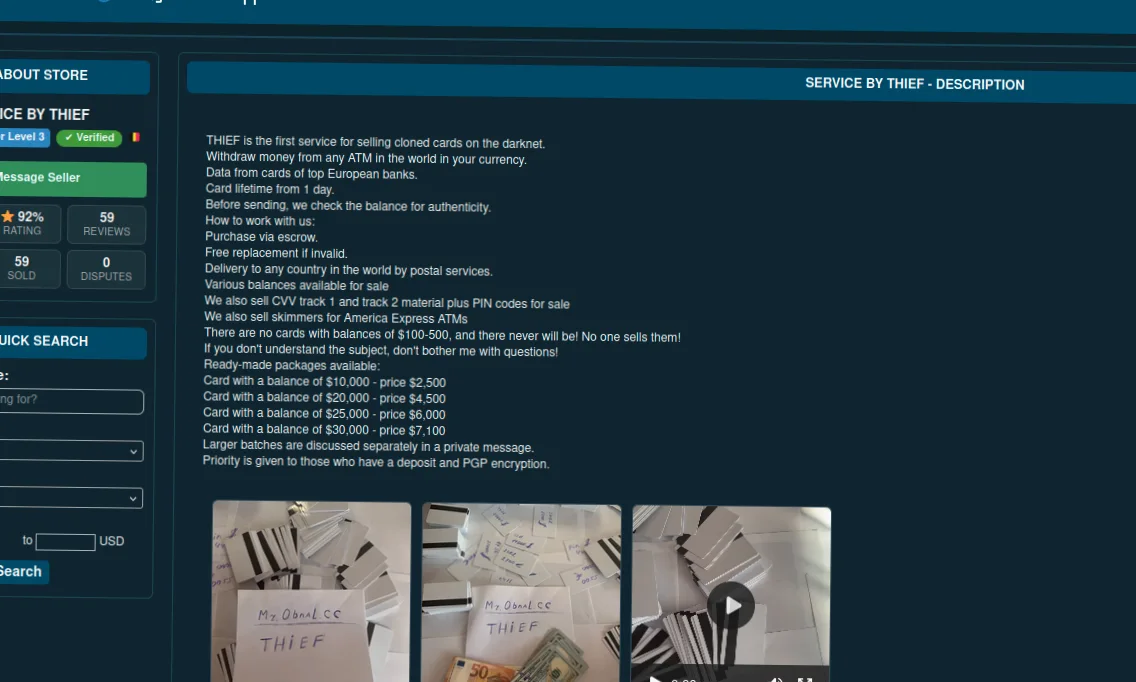
Mark T., 34, thought he'd cracked the system. Six cloned cards with PIN codes, purchased with cryptocurrency, delivered in neutral packaging — the classic carding setup. The first three ATMs handed him $4,200 without a hitch. The fourth ATM handed him to the Secret Service.
This isn't your usual how-to guide or cautionary tale about dark web dangers. It's a forensic breakdown of how a seemingly invisible crime became a textbook case for investigators, how 23 seconds of ATM footage unravelled two weeks of planning, and why crypto anonymity crumbles the moment you step in front of a camera.
You'll see the timeline, the mistakes, the evidence chain, and the numbers that sent Mark from his Tampa apartment to a federal courtroom in 72 hours.
The Carding Chain: How the System Works
Carding is a prevalent form of cybercrime that continues to thrive despite technological advancements. This persistence can be attributed to the straightforward methodology it employs: data collection, card forgery, cash withdrawal, and evasion. Mark’s operation closely mirrored this framework.
Let’s break down how cloned cards are obtained:
Data theft: Criminals collect track 1 and track 2 information through various techniques, including physical skimmers on ATMs, phishing schemes, shimmer devices, or by obtaining large datasets from dark web marketplaces.
Card creation: The acquired data is transferred onto blank plastic cards using a magnetic stripe writer. These counterfeit cards are crafted to appear authentic, complete with details such as the cardholder's name, card number, and expiry date.
PIN collection: If the PIN was captured via a concealed camera or overlay keypad (a quick search for ATM skimmer images will demonstrate how prevalent this is), the buyer now possesses a fully operational card for accessing funds.
Withdrawal: The buyer swiftly utilizes ATMs to extract cash before the victims become aware of the fraud and manage to freeze their accounts.
Money laundering: The withdrawn cash is subsequently converted into cryptocurrency, effectively obscuring the trail of the transaction.
Mark spent $480 on Monero, selected for its enhanced privacy features compared to Bitcoin. The cards were sent discreetly, allowing the operation to proceed smoothly. However, there’s a crucial point that often gets overlooked: ATMs are not merely cash machines; they continuously gather data.
Before assuming that physical crimes can slip through digital cracks, remember this: every withdrawal generates a detailed record linking time, location, identity, and transaction via a straightforward database query. So, next time you think about a quick score, consider the eyes that might be watching.
The Vulnerability No One Sees: ATM Surveillance
Modern ATMs are not just machines that dispense cash; they also act as hidden surveillance tools. Mark realised this during his visit to his fourth ATM in the Tampa Bay area, which resulted in a rather annoying ordeal that lasted for 60 months.
These machines gather crucial details throughout transactions, including:
Front camera: This device captures your face in impressive 1080p resolution and is frequently enhanced with infrared capabilities for better visibility in low-light conditions.
Hidden secondary camera: Many ATMs feature an extra camera that is not visible to users, allowing for the capture of angles that would otherwise go unnoticed.
Transaction logs meticulously document every withdrawal, noting the status, ATM ID, card number, amount, and time.
Geolocation tracking: The precise location of the ATM is transmitted to the bank's centralized system.
Network activity: Details about the requests handled by the ATM are recorded, including connection specifics.
When Mark withdrew $700 from that particular ATM, his face was unmistakably clear on the footage. He hadn’t donned a mask or any accessories. The video, lasting a mere twenty-three seconds, provided undeniable evidence that required no tweaking—just a straightforward database lookup.
Many people erroneously think that their online anonymity applies in the real world. Sadly, this isn’t the case. An ATM converts digital misconduct into concrete evidence, leaving absolutely no space for anonymity. If your focus is solely on spotting a card reader skimmer, you might overlook the bigger picture—being prepared for the fallout when that camera captures your actions.
The Investigation Timeline: 15 Days to Arrest
Fraud cases demand immediate attention, and Mark's story exemplifies this, as significant events unfolded in a mere 15 days. Here’s the timeline of how it all transpired:
Day 1 (November 2024): On this day, three people from Florida, Georgia, and North Carolina report unusual withdrawals from their accounts. Their banks respond promptly by freezing the affected cards and initiating a fraud investigation.
Day 3: The bank's fraud detection systems identify a concerning pattern: numerous rapid withdrawals from cloned cards across different states. This triggers an urgent response from the bank’s investigative unit.
Day 5: The case is passed to the U.S. Secret Service, the federal agency responsible for investigating financial crimes. An analyst requests transaction details and surveillance footage from the affected ATMs to support the inquiry.
Day 8: CCTV footage from one ATM reveals a clear image of a suspect. In a follow-up process, it was determined that Mark T., who has no criminal history, matched images taken against the records held by the Florida Department of Public Safety. It was revealed through analysis that a 40-mile radius from his home encompassed all the withdrawals.
Day 12: A warrant is secured to examine Mark's digital activities. It was found by investigators that during the fraudulent transactions, Tor exit nodes had been accessed by him. They also uncover a wallet associated with Monero, tied to a darknet marketplace related to his cryptocurrency dealings.
At Mark’s residence, a search warrant was executed by authorities on Day 14. At Mark's home, six blank cards, a device for reading and writing magnetic stripes, a laptop with evidence of his darknet activities, and $3,200 in cash were found during a search.
On Day 15, custody was taken of Mark. While being questioned, he acknowledges having used four out of the six cards to withdraw cash, stating that the bank had already disabled the other two when he tried to use them.
Though the court documents do not disclose the platform he utilised for his purchases, investigators successfully linked his transactions to the exchange from which he acquired his Monero. This crucial connection tied his identity to the larger fraud operation, illustrating how quickly justice can track down those who think they can evade capture.
The Numbers That Mattered
Let's break down what Mark gained versus what he lost. The mathematics of federal sentencing rarely favour the defendant.
| Metric | Value |
|---|---|
| The total number of ATM withdrawals was 4. | |
| The sum of $4,900 was withdrawn. | |
| The price for cloned cards is $480. | |
| Days from withdrawal to arrest | 15 |
| A federal prison sentence of 60 months (5 years) was imposed. | |
| A total of $22,000 was imposed as a fine and restitution. | |
| After serving a federal prison sentence of 5 years (60 months), the individual will be under supervised release for 3 years. |
Mark netted $4,420 after expenses. That works out to roughly $884 per year of prison time, or $73.67 per month. Before accounting for the $22,000 he now owes.
These numbers don't include legal fees, lost employment, or the three years of supervised release where any violation sends him straight back to prison. If you're evaluating risk versus reward in carding schemes, these figures should recalibrate your calculation.
The website where the purchase was made remains unnamed in court documents, but investigators traced Mark's activity through the exchange he used to buy Monero — a centralised platform requiring KYC verification.
Why Cryptocurrency Didn't Provide Cover
Monero is designed for anonymity. Mark selected this cryptocurrency due to its enhanced difficulty in tracing transactions compared to Bitcoin. However, the shield of cryptocurrency didn’t hold up. Let’s look at the breakdown:
Initial Access: Mark acquired Monero through a centralised exchange that necessitated KYC checks—this involved uploading his passport, a selfie, and proof of residency. Following a court order, the exchange revealed his identity and transaction records. Although tracking later Monero transactions is challenging, the purchase on the exact date and specified amount served as incriminating evidence.
Timing Details: From Monero purchase to marketplace order, card delivery, and ATM withdrawals—all these actions occurred in a tight two-week span. The synchronous nature of these events created circumstantial but persuasive evidence when considered alongside other elements.
Tangible Proof: The cards seized in the investigation held magnetic tracks that corresponded with data stolen from genuine victims. This is undeniable physical proof that no cryptocurrency can eliminate.
Visual Evidence: Footage capturing a face is a type of evidence that cannot be disguised or obscured by any blockchain technology. Even if all other aspects were flawlessly executed, the video alone linked Mark to the crime scene.
Conversations on platforms like cloned cards reddit and card skimming reddit often delve into the technicalities of card skimming prevention or methods to identify credit card skimmers. While these topics are indeed important for safeguarding against such risks, they overlook a significant truth: once you step into the realm of using cloned cards, your main concern shifts from the skimmer to the extensive surveillance systems in place at cash-out locations.
Mark's Six Critical Mistakes
Mark made a series of significant errors in his security approach. Each blunder built upon the last one:
Location of transactions: The four ATMs he used were all less than 40 miles from his residence. This sort of concentration can easily trigger fraud detection systems, which are designed to pick up on suspicious activity.
No attempt to conceal identity: He didn’t wear any disguises like masks, hats, or glasses. A clear image of his face on surveillance footage allows law enforcement to quickly identify him using public databases.
Using a centralised exchange for Monero: His actual identity was tied to the cryptocurrency he used on the dark web due to KYC regulations. While peer-to-peer transactions might provide some level of anonymity, they are far from foolproof.
During the search of his property, items such as blank cards, an MSR device, and a laptop containing a record of his activities were discovered. Even attempts to delete evidence can leave traces; for instance, the Tor Browser can retain information, and system logs might indicate its use.
Matching cash amounts: The $3,200 found during the investigation corresponded to the denominations dispensed by the ATM, further substantiating the case against him.
Rapid transaction period: All cash withdrawals were made in just two weeks. Had he spaced them out over a longer duration, it might have reduced the likelihood of detection. However, camera footage would still have caught him.
Before you consider any activities involving card cloning or think about investing in a skimming device detector, remember this: the real risks often stem from human behaviour, not just the technology involved. While protective measures against card skimming are essential, they won't safeguard you after the fact.
What Security Professionals Should Learn
Mark's experience underlines an essential element of security measures. It showcases how effective a multi-layered approach can be when every component functions properly. If you work in cybersecurity or fraud prevention, consider these important insights:
Your primary defence consists of anti-fraud systems: Such systems utilise a variety of tools like pattern recognition, geolocation tracking, and automated scoring models that operate without human oversight. Continuing to enhance machine learning algorithms for spotting irregularities is vital, as they greatly accelerate the investigation process.
Combining physical and digital forensics is crucial: The main evidence in this instance stemmed from ATM footage. However, without the relevant digital transaction logs, that footage is of limited use — it is imperative to determine the precise moment to capture a frame. Integrating these two domains is necessary for executing thorough investigations.
The notion of "anonymous" cryptocurrencies is a misconception: KYC-compliant exchanges and cash withdrawal points establish a traceable link between digital transactions and physical actions. Complete anonymity isn't possible given KYC regulations.
Informing customers helps to lessen losses: A number of victims were initially oblivious to the fraudulent activities. Prompt reporting of theft enables banks to block cards quickly, which diminishes the likelihood of further withdrawals by fraudsters. Banks’ educational efforts can greatly reduce the financial burden on their customers.
If you are developing tools designed to combat card skimming, remember that detection is only part of the answer. The other aspect involves surveillance systems that collect evidence after an incident occurs. Knowing how to recognise a card skimmer becomes less critical when comprehensive monitoring systems are in place.
The Verdict and What It Means
The charges of fraud and money laundering were confessed to by Mark T. in March 2025, as specified in the federal statutes 18 U.S.C. § 1029 and 18 U.S.C. § 1957. A federal facility sentence of 60 months was imposed on him by the U.S. District Court for the Middle District of Florida, followed by a three-year supervised release. Furthermore, the court mandated that he pay a fine of $22,000 along with restitution to three individuals affected by his actions.
During the proceedings, it was highlighted that Mark was not the leading figure in the criminal enterprise; instead, he was the final purchaser in a much larger operation. Understanding this nuance is vital, as those lower in the hierarchy often face immediate consequences, while the true masterminds frequently evade capture. This situation illustrates the challenges law enforcement encounters in tackling such crimes effectively.
As a reader, it’s essential to grasp the bigger picture beyond avoiding illegal online markets. You should recognise where true anonymity ceases to exist. Once you’re recorded on video, that fleeting 23 seconds of footage will outweigh any perceived cover offered by cryptocurrency.
Continue with
 Hiddenwiki onionExplore the Hidden Wiki on the dark web: discover links, resources, and safety tips for your journey into this hidden online world.
 Derek H.'s Counterfeit Cash Caper: How Ambition Turned to ArrestHow a Denver man's plan to deposit counterfeit $100 bills into ATMs collapsed within 72 hours — and why banks always catch this scheme.